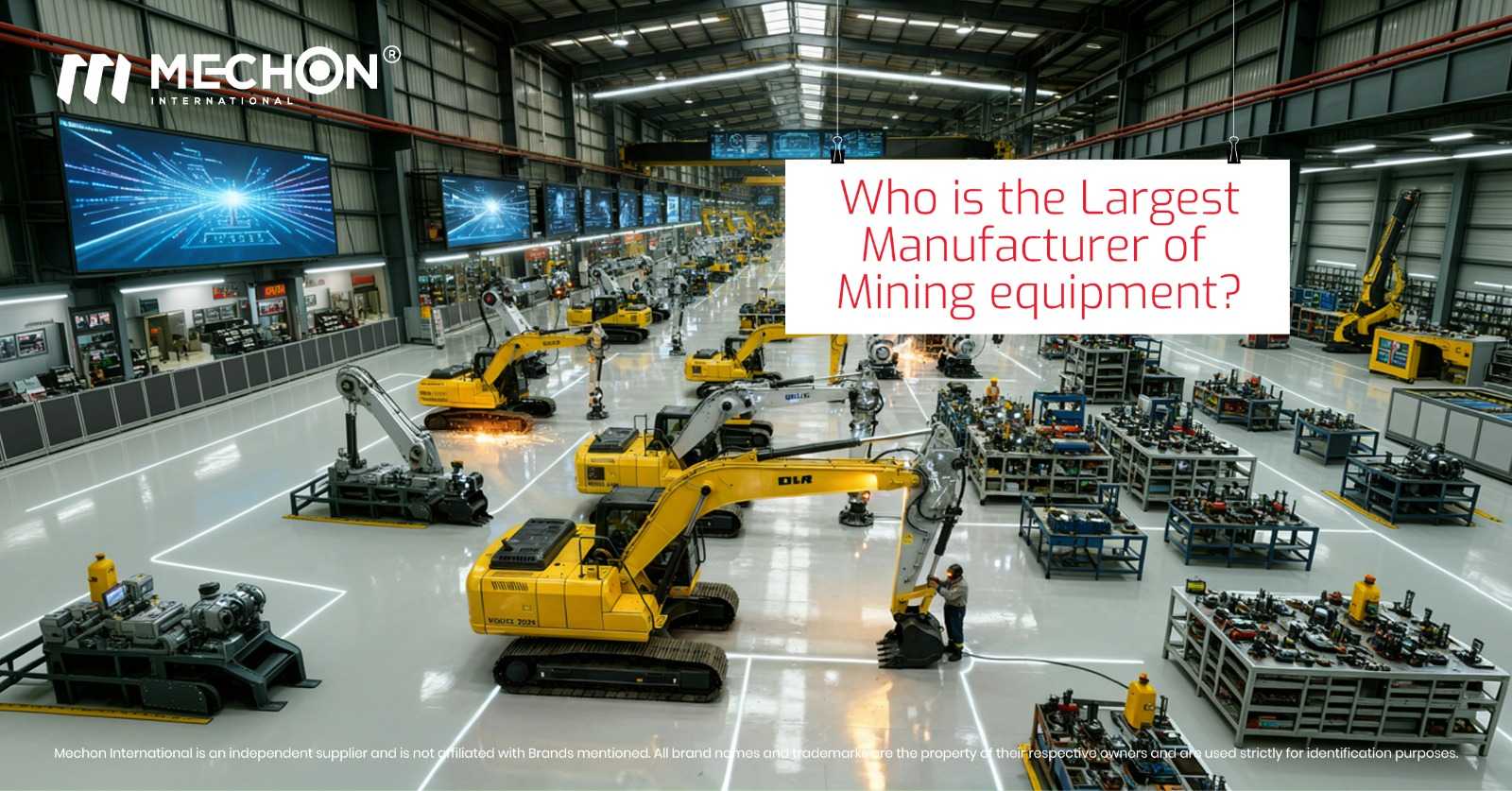
Who is the largest manufacturer of mining equipment ?
Look at your smartphone. Every gram of metal inside it started in the bed of a machine so large it could crush a suburban home. But who builds these giants?
When measured by revenue, Caterpillar (USA) sits firmly on the throne as the world’s largest mining equipment manufacturer. Industry analysts track this dominance through the "Yellow Table," the authoritative annual scoreboard ranking the top mining equipment suppliers by sales figures rather than just brand popularity.
This leadership relies on "ultra-class" machinery—vehicles designed on a scale that defies logic. A single haul truck, for example, carries a payload equal to 250 mid-size sedans, separating true heavy machinery manufacturers from standard construction brands.
Why does the Caterpillar Stand at the Peak of the Mining Mountain ?
If you walk past a construction site, you almost certainly see yellow paint. In the much harsher world of mining, that same distinct color signifies the undisputed king of the hill. Caterpillar (USA) currently holds about 16% of the global market, a massive lead that solidifies its status as the largest mining equipment manufacturer in the world. In industry terms, they are the leading OEM (Original Equipment Manufacturer), designing and building the primary machines themselves rather than just supplying parts to others.
To understand why they lead, look at their flagship monster, the 797F. This isn't just a big truck; it is essentially a moving building. Its defining feature is its "payload capacity," the maximum weight of rock or dirt the bed can carry without structural failure. The 797F boasts a payload of 400 tons. For perspective, a single trip carries the equivalent weight of nearly 200 mid-sized SUVs or 60 adult elephants. This immense scale requires extreme heavy-duty haul truck durability, as these machines must run 24 hours a day in some of the most hostile environments on Earth.
Yet, building a massive truck is only half the battle. Caterpillar’s true dominance comes from what happens when something breaks in the middle of a remote desert. Since mining operations lose thousands of dollars every minute a machine sits idle, quick repairs are vital. Cat has established a global dealership network that functions like a 24-hour emergency room for machines, ensuring parts reach the most isolated mines faster than competitors.
Being the biggest doesn't always mean being the only innovator, however. While the American giant relies on brute strength and vast networks, a fierce rival across the Pacific is challenging the status quo. The Japanese contender is taking a different approach, betting heavily on the high-tech future of automation.
Komatsu: The High-Tech Rival Dominating the Robotics Frontier
If Caterpillar is the heavyweight boxing champion, Japan’s Komatsu is the agile martial artist. Firmly established as the second-largest mining equipment manufacturer, Komatsu commands a significant portion of the global market by focusing less on sheer muscle and more on silicon brains. While they build massive dump trucks that rival any competitor in physical scale, their true competitive edge lies in how those machines think.
Imagine a vehicle the size of a house navigating a busy worksite without a human behind the wheel. This is reality with Komatsu’s FrontRunner Autonomous Haulage System (AHS). Unlike standard trucks that rely on a driver’s eyes, these advanced autonomous mining vehicle manufacturers use precise GPS and radar to navigate mines with sub-centimeter accuracy. These "ghost trucks" operate continuously, stopping only for fuel, which drastically improves safety by removing human fatigue from the equation.
Beyond self-driving capabilities, Komatsu differentiates itself under the hood. Instead of using a traditional transmission like a car, they popularized electric drive systems where a diesel engine acts as a generator to power electric motors at the wheels. Their innovations in remote-controlled mining systems currently lead the industry in three specific areas:
- Autonomous Haulage: Fleets that communicate with each other to optimize traffic flow.
- Electric Drive: Efficient power delivery that provides smoother acceleration and less maintenance.
- Teleoperation: Allowing operators to control bulldozers from comfortable offices miles away from the danger zone.
While these giants rule the surface, a different set of European specialists dominates the dark tunnels below.
Underground Titans vs. Surface Giants: Sandvik, Epiroc, and Liebherr
Leaving the open air of surface mines changes the game entirely. While Caterpillar and Komatsu build house-sized trucks for open pits, those giants simply cannot fit inside deep subterranean tunnels. This tailored environment requires low-profile, agile machinery capable of navigating tight spaces thousands of feet below the surface. This is the domain of hard-rock mining, where equipment must be compact yet powerful enough to chew through solid granite without touching the low ceilings.
Two Swedish heavyweights, Sandvik and Epiroc, control the majority of this claustrophobic market. Their engineering focuses on specialized vehicles like the LHD (Load-Haul-Dump), which essentially looks like a front-end loader that has been squashed flat to squeeze into narrow drifts. These companies drive the Sandvik and Epiroc underground drilling comparison by offering high-tech rigs that drill precise holes for explosives, ensuring miners can extract valuable metals like gold or copper without collapsing the tunnel around them.
Germany’s Liebherr dominates a different niche, renowned specifically as one of the premier high-capacity hydraulic mining shovel manufacturers. Their massive white excavators serve as the primary muscle in open pits, scooping tons of earth in a single pass to fill the giant haul trucks. Once this raw material is extracted, it must be pulverized to separate the valuable metal from the waste, a critical step handled by the best rock crushing and grinding machinery from specialists like Finland’s Metso Outotec.
Regardless of whether the machinery operates under the sun or miles beneath it, every major player is currently facing the same technological revolution. The industry is rapidly moving away from brute force diesel power toward cleaner energy and sharper artificial intelligence.
Electric Hearts and Invisible Drivers: The Future of Mining Machinery
The roar of diesel engines is fading in favor of the silent hum of high-voltage batteries. Manufacturers are racing to develop sustainable electric mining fleet solutions to meet strict "net-zero" goals, but the challenge is immense compared to consumer vehicles. Unlike a sedan carrying a family, these beasts must haul 300 tons uphill without draining their cells. Consequently, success is now defined by battery efficiency rather than simple horsepower.
Software is rapidly becoming as valuable as the steel itself. Modern sites often feature "invisible drivers," where trucks navigate routes entirely via GPS to improve safety. This technological pivot impacts the global heavy machinery industry revenue ranking, as investors now value innovation as highly as manufacturing capacity. Companies must modernize or risk losing their standing to smarter competitors in the definitive list of industry leaders.
Get future ready with Mechon International, GET A FREE QUOTE NOW.
