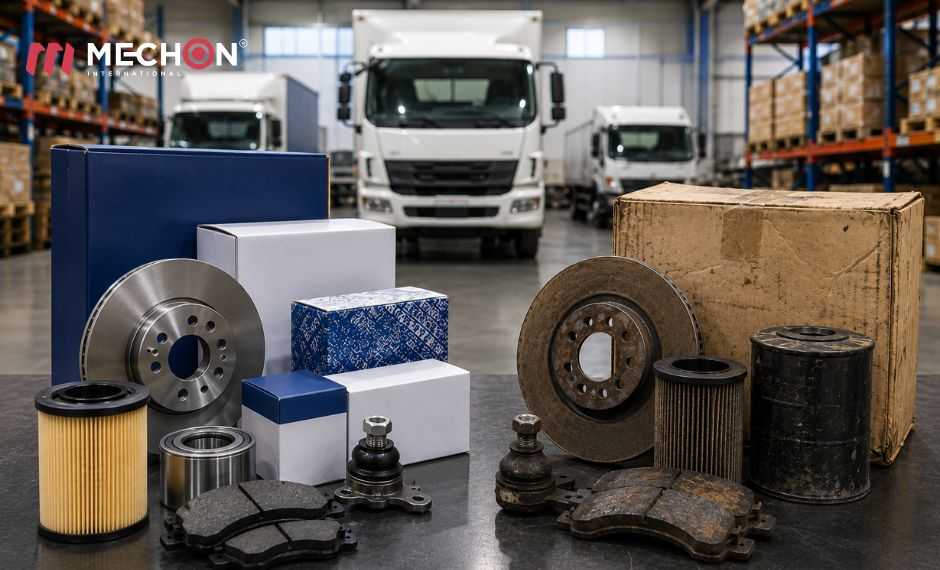
Genuine vs Aftermarket Hyundai Parts: What Fleet Owners Should Know
Have you ever been in this situation? Your Hyundai excavator, loader or truck breaks down, sits idle, and two price estimates appear on your desk; one for an OEM part from Hyundai and another one for the same part at a lower price by an aftermarket supplier. It is a relatively small choice but the difference is huge. Numerous questions really arise on your jobsite. Here in this blog, there is nothing technical, nothing promotional, just the straight information that fleet owners of UAE and GCC should know.
What is the Real Difference Between Genuine and Aftermarket Hyundai Parts?
Hyundai genuine parts are produced using identical engineering and production processes used to produce the original part, including the use of identical materials and identical tolerances for testing and manufacturing the parts at the time when the equipment was first manufactured. On the other hand, an aftermarket part would be produced by a third-party producer who copies only the function of the original part and does not always copy the original design used to make the part.
In simple terms, this means that a genuine Hyundai hydraulic pump or any engine part will be made to withstand certain stress factors as designed by the Hyundai engineers when building the equipment. By partnering with a Hyundai spare parts supplier in UAE, you will get access to the authentic product line up of Hyundai without any complex procedures.
Are Aftermarket Hyundai Parts Really Bad or a Gamble?
Not all of them are necessarily bad but certainly very unreliable. The manufacturing standards of the aftermarket parts differ drastically between different suppliers. Some of the aftermarket filters, belts or seals provide quite acceptable performance. Other ones will simply break down way earlier than their lifetime expectancy, and some will actually harm other elements in case of mismatching tolerances.
The straightforward explanation is that with the genuine parts you get an exact same part every time while with the aftermarket parts, it’s just like experimenting.
Why do these factors affect fleet owners more than single machine operators?
The size makes the numbers different. With only one machine at your disposal, a faulty component is just an annoyance. With a fleet of ten or twenty excavators, on the other hand, something that breaks 15% more frequently than expected is a recurring expense that occurs each month for all excavators equipped with that part.
Uncertainty is another problem for those running a fleet. With a genuine part, there will be a guaranteed service interval. With a counterfeit part, it is not possible to know when exactly the next service will have to take place.
Do Genuine Parts Really Reduce Downtime?
The idle time on the machinery is rarely due to the price of the part; rather, it is caused by the machinery being idle because of a project being delayed, by the labor force being idle, and the cost of restarting the machinery after the incorrect part has caused a secondary malfunction.
The real reason why OEM parts reduce idle time is that the parts fit within the original tolerances, which allows them to be installed without any difficulties and work reliably during the time frame expected.
Relying On Aftermarket Parts For Saving Money – Does that Make Any Difference?
Fleet operators that consider total cost of ownership and not merely the initial price of the product often discover that the cost equation is reversed after some time. Where the cost of a real part that lasts the complete lifespan of its rating without damaging neighboring parts is lower per operating hour relative to a cheap part that has to be replaced double the number of times or damages other parts in the system. When assessed the cost of operation becomes clear.
Does Using an Aftermarket Part Affect the Machine’s Warranty
This is also one of the most ignored dangers. In some cases, depending upon the type of warranty and the component being replaced, using aftermarket parts may influence the warranty coverage, especially when it turns out that it was the aftermarket part that caused the problem. It is always wise for fleet owners to review their warranty information before replacing any genuine parts.
How To Make Sure You Are Dealing With a Genuine Supplier?
It is expected that a reputable parts supplier will be able to provide sourcing information such as the origin of the part, certification for the authenticity of the part, as well as proper packaging and part numbering that corresponds to the manufacturer's inventory. It is best to consider any suspicious sourcing information, unusually low prices, or lack of certification from suppliers to be red flags.
All parts supplied by us at Mechon International, the heavy equipment spare parts supplier in UAE, are carefully sourced with emphasis on authenticity due to our reliable sourcing network in the GCC, Africa, and beyond. Fleet owners do not have to wonder about the authenticity of the part, because we provide th best with every kind of certifications.
So Which One Should Fleet Owners Actually Choose?
In the case of vital equipment like the engine, hydraulics, transmissions, undercarriage components, it will usually be better for fleet managers to choose genuine parts because the cost of an unexpected failure or stoppage will adversely affect the savings achieved through choosing the aftermarket alternative.
What is important is not that "genuine is always correct" or "aftermarket is always incorrect." The important point is that a conscious choice should be made on a case-by-case basis, with clear understanding of the trade-offs involved, and not just based on the cheapest choice when there is failure.

Rahul Menon
[ Senior Sales & Technical Manager ]
Rahul Menon [ Senior Sales & Technical Manager ]
Rahul Menon is a highly experienced industry expert with a strong background in heavy mining and construction equipment solutions. He has extensive knowledge of ground engaging parts, undercarriage components, and hydraulic systems, enabling him to deliver reliable technical guidance and tailored solutions to clients. With a customer-focused approach and deep understanding of equipment performance in demanding environments, Rahul plays a key role in supporting project requirements, optimizing machine efficiency, and ensuring long-term operational success.
